
Kadidiatou Touré, PhD student at EPOC, winner of the L’Oréal-UNESCO For Women in Science Award

A great recognition for the research conducted at EPOC: Kadidiatou Touré, PhD student at the University of Bordeaux in the EPOC laboratory, is one of 35 young scientists distinguished by the 20th L’Oréal-UNESCO Prize for Women and Science France.
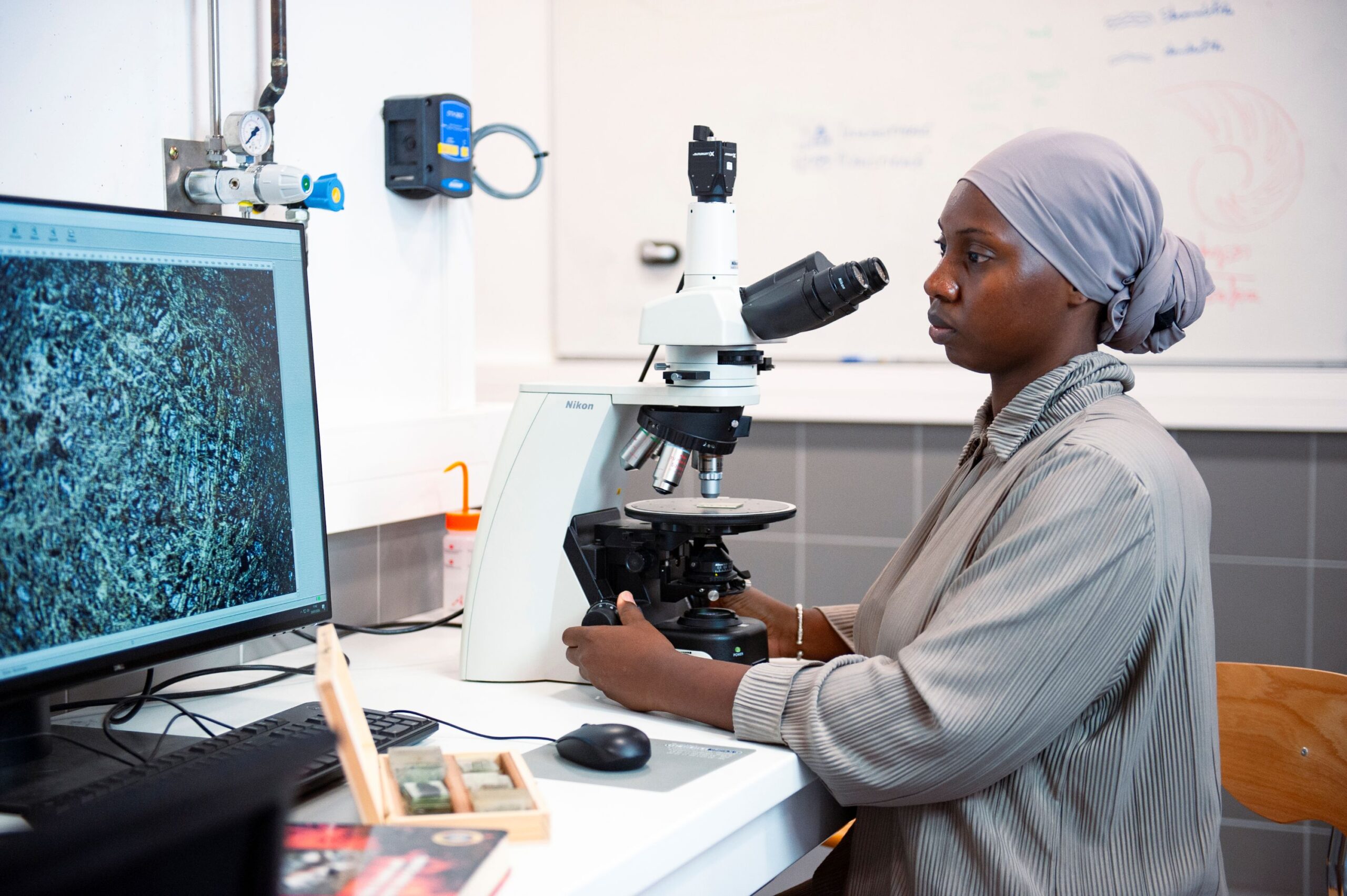
©Kadidiatou Touré

Kadidiatou’s research focuses on natural hydrogen, a form of hydrogen produced naturally deep within the Earth.

Her work aims to gain a better understanding of how this hydrogen forms, circulates and accumulates underground, in order to identify the conditions under which it might be present in quantities that can be exploited.

Already used in several industrial and energy sectors, hydrogen could play a role in the transition to low-carbon energy systems. Natural hydrogen is therefore an emerging field of research, the potential of which has yet to be fully characterised.


For Kadidiatou, this research has very personal roots.

Born in Bamako, Mali, she discovered as a teenager the existence of a natural hydrogen deposit located near her hometown. This discovery sparked her curiosity and helped steer her towards Earth sciences.

After studying geology in Morocco and then at Aix-Marseille University, she is now continuing her scientific career at the University of Bordeaux, within the EPOC laboratory.

Her journey also illustrates the importance of making science accessible and showing that scientific careers are open to everyone.

“Never think that certain disciplines aren’t for you.”

The L’Oréal-UNESCO For Women in Science France Prize is organised by the L’Oréal Foundation and the French Academy of Sciences. The 35 laureates of this 20th edition were selected from over 800 applications.

EPOC Information – September 2026

Similar articles

PALEOCLIMATOLOGY | Thomas Extier, senior lecturer at the EPOC laboratory

Thomas Extier, lecturer at the University of Bordeaux and researcher at EPOC laboratory, presents his profession as a paleoclimatologist and his work devoted to the study of past climates. ©EPOCWithin the PALEO team, Thomas Extier studies in particular the...

Why did the glacial cycles go from 40,000 to 100,000 years? – PODCAST RADIO France

On September 3, 2026, María Sánchez Goñi was invited to appear on the program "Avec sciences" of France Culture to discuss the transition of the Middle Pleistocene and the change in rhythm of glacial cycles. ©EPOC Nearly a million years ago, the Earth’s glacial cycles...

A student from Saint-Jean-de-Luz gives her name to a new marine species discovered by EPOC researchers

On Thursday 2 July 2026, the town of Saint-Jean-de-Luz welcomed pupils taking part in the Aires Marines Éducatives (AME) programme, an initiative designed to raise awareness among the younger generation about the coast and its conservation.On this occasion, a pupil...

Toufic Mazloum | PhD student at the EPOC laboratory, presents his work on geological and seismic modeling

In a video interview, Toufic Mazloum explains his thesis work on the geological and synthetic seismic modeling of the sub-basin of Aínsa, in the Spanish Pyrenees. He presents his research topic, the issues of his field and his background at the EPOC laboratory.©EPOC...

Emmanuelle Ducassou has been appointed coordinator of the European MSCA – C-BRINES project, ‘Global climate impacts of extreme brine input to the ocean’

The EPOC laboratory is involved in a new European project coordinated by Emmanuelle Ducassou. The C-BRINES project (“Global climate impacts of extreme brine input to the ocean”) has been selected under the Marie Skłodowska-Curie Doctoral Networks scheme, a highly...

Career profile: an interview with Alexis Bonnet, Mechanical Production Technician at the laboratory.

Having joined the Arcachon Marine Station in November 2025, Alexis Bonnet ensures the smooth running of the technical facilities essential to the research carried out at EPOC. Between maintenance, adapting to new requirements and dealing with the unexpected, he tells...

Pint of Science event in Bordeaux! Three members of the EPOC laboratory will be sharing their research on 18 and 19 May!

From 18 to 19 May 2026, the Pint of Science event is making a comeback in Bordeaux. To mark the occasion, three members of the EPOC laboratory will be meeting the general public to share their research in a friendly and accessible setting.©EPOCThe Pint of Science...

My thesis in 180 seconds, Joanne Couallier, finalist from the University of Bordeaux

The challenge of this competition is to explain your research topic in just three minutes! A challenge that Joanne Couallier, a PhD student in climatology at the EPOC Laboratory, has taken up.©Kéwann MoreauOn 2 April 2026, the University of Bordeaux hosted the final...

EPOC Laboratory General Assembly 2026: a day of review and discussion at the Domaine du Haut Carré at the University of Bordeaux

The EPOC laboratory met on 30 January 2026 for its General Assembly, held at the Domaine du Haut Carré and hosted by the University of Bordeaux.©Kéwann MoreauThe day provided an opportunity to review the actions carried out in 2025 and share future prospects....

Lecture at ENSEGID by Professor Steven Loheide DARCY LECTURE 2026 on 16 March 2026

On Monday, 16 March 2026, at 2:00 p.m., ENSEGID (Bordeaux INP) will have the honour of welcoming the 2026 Darcy Lecturer, Professor Steven Loheide, a lecturer and researcher at the University of Wisconsin–Madison and an international expert in hydrology and...