
EPOC
In a few words
EPOC is a joint research unit supervised by several organisations : CNRS, Université de Bordeaux, Bordeaux-INP and École Pratique des Hautes Études (EPHE). It has a staff of 250 (researchers, lecturers, administrative support staff, doctoral students and post-doctoral students) with multidisciplinary expertise in ecotoxicology, ecology, biogeochemistry, environmental chemistry, sedimentology, hydrogeology, palaeoclimatology, coastal oceanography and geosciences. EPOC studies the function and dysfunction of ecosystems by focusing on the various environmental compartments – water, air, soil – and the interfaces they share, seeking to characterise the pressures, forcings and impacts in order to understand both local and global trajectories and changes. A wide variety of research projects have been carried out, dealing with issues of transfers, flows and processes. They involve characterising biodiversity, studying the ecodynamics of organic micropollutants and trace metals, and the organic matter cycle. They cover the reconstruction and forcing studies of climate variability, as well as the study of the architecture of sedimentary basins and the study of hydrodynamic and sedimentary processes.


Latest news
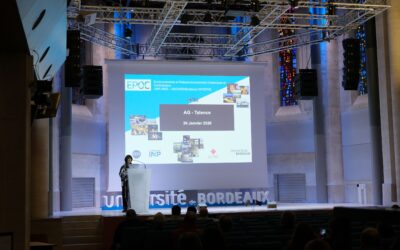
EPOC Laboratory General Assembly 2026: a day of review and discussion at the Domaine du Haut Carré at the University of Bordeaux
The EPOC laboratory met on 30 January 2026 for its General...
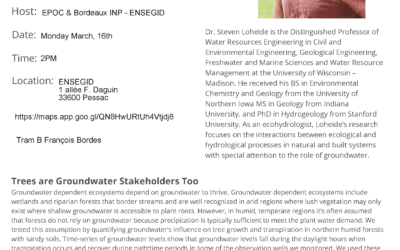
Lecture at ENSEGID by Professor Steven Loheide DARCY LECTURE 2026 on 16 March 2026
On Monday, 16 March 2026, at 2:00 p.m., ENSEGID (Bordeaux...

PFAS, the eternal pollutants present in our waters – Le Parisien newspaper and Pierre Labadie
In this article, the newspaper Le Parisien interviews...
Key figures

250 EMPLOYEES

8 TEAMS
10 PLATFORMS

572 CONTRACTS SINCE 2012

260 DISSERTATIONS DEFENDED SINCE 2012

EDUCATION 20 sectors supported by EPOC
EPOC’s presence around the world
EPOC staff conduct research at various regional, national and international levels through projects and/or collaborations. The research work carried out covers a wide variety of environments (air/water/soil) and is part of a partnership involving many countries around the world: from the Arctic to the Antarctic, via Europe, Africa, Asia, the Americas, etc. Some of the research is carried out in territories with specific challenges, such as overseas territories. EPOC also has a recognised activity in relation to the poles.