
The EPOC laboratory is involved in a new European project coordinated by Emmanuelle Ducassou. The C-BRINES project (“Global climate impacts of extreme brine input to the ocean”) has been selected under the Marie Skłodowska-Curie Doctoral Networks scheme, a highly competitive programme at European level.
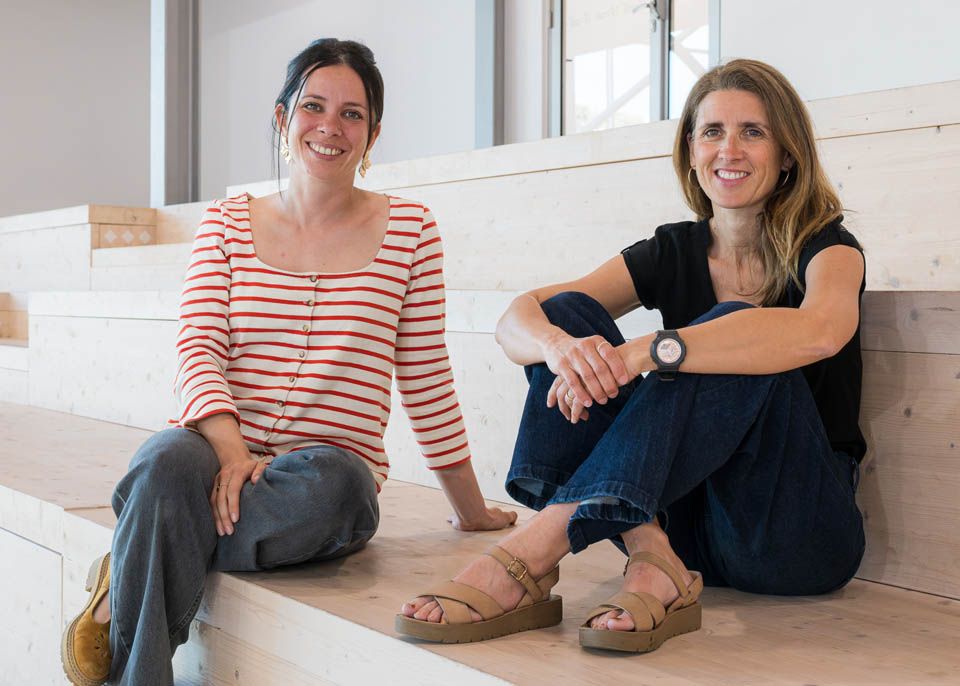
Camille Jeunet-Kelway (left) and Emmanuelle Ducassou, both recipients of an MSCA Doctoral Network grant © Gautier Dufau
Understanding the mechanisms of CO₂ storage in the ocean
In the context of climate change, the ocean plays a central role as the planet’s main carbon sink. One of the avenues currently being explored involves enhancing its capacity to absorb and store atmospheric CO₂. However, the consequences of altering the ocean’s chemistry remain largely unknown.
“If we alter the ocean’s chemistry, we can imagine capturing more CO₂. But what would that mean for the density of the water? What consequences would there be for currents or for living organisms? We do not yet have a comprehensive understanding of these effects,” says Emmanuelle Ducassou, a researcher at the EPOC laboratory.
The aim of the C-BRINES project is to provide some answers to these questions.
Looking to the past to shed light on the future
To better understand these mechanisms, researchers are drawing on an exceptional natural event: the drying up of the Mediterranean Sea over 5 million years ago. This event, linked to the closure of the Strait of Gibraltar, profoundly altered the salinity and temperature of the oceans, whilst leading to the massive formation of salt deposits. “The idea is to test and perhaps validate a new technique for achieving carbon neutrality by gaining new insights into a past environmental crisis,” says Emmanuelle Ducassou, a researcher at the EPOC laboratory.
Training a new generation of researchers
With a budget of over €4.6 million, the C-BRINES project will enable the recruitment of 15 PhD students. Beyond the expected scientific advances, the project has a strong ambition: to train a new generation of researchers capable of working at the interface of several disciplines.
“We also need our PhD students to speak the same language when it comes to climate,” explains Emmanuelle Ducassou, a researcher at the EPOC laboratory.
Through this initiative, the EPOC laboratory reaffirms its commitment to structuring projects at European level, helping to advance knowledge on major contemporary environmental challenges.
More informations : https://www.u-bordeaux.fr/actualites/deux-projets-europeens-pour-former-une-nouvelle-generation-de-chercheurs-et-chercheuses
EPOC informations – may 2026