
Career profile: an interview with Alexis Bonnet, Mechanical Production Technician at the laboratory.

Having joined the Arcachon Marine Station in November 2025, Alexis Bonnet ensures the smooth running of the technical facilities essential to the research carried out at EPOC. Between maintenance, adapting to new requirements and dealing with the unexpected, he tells us about a vital role at the heart of the field.
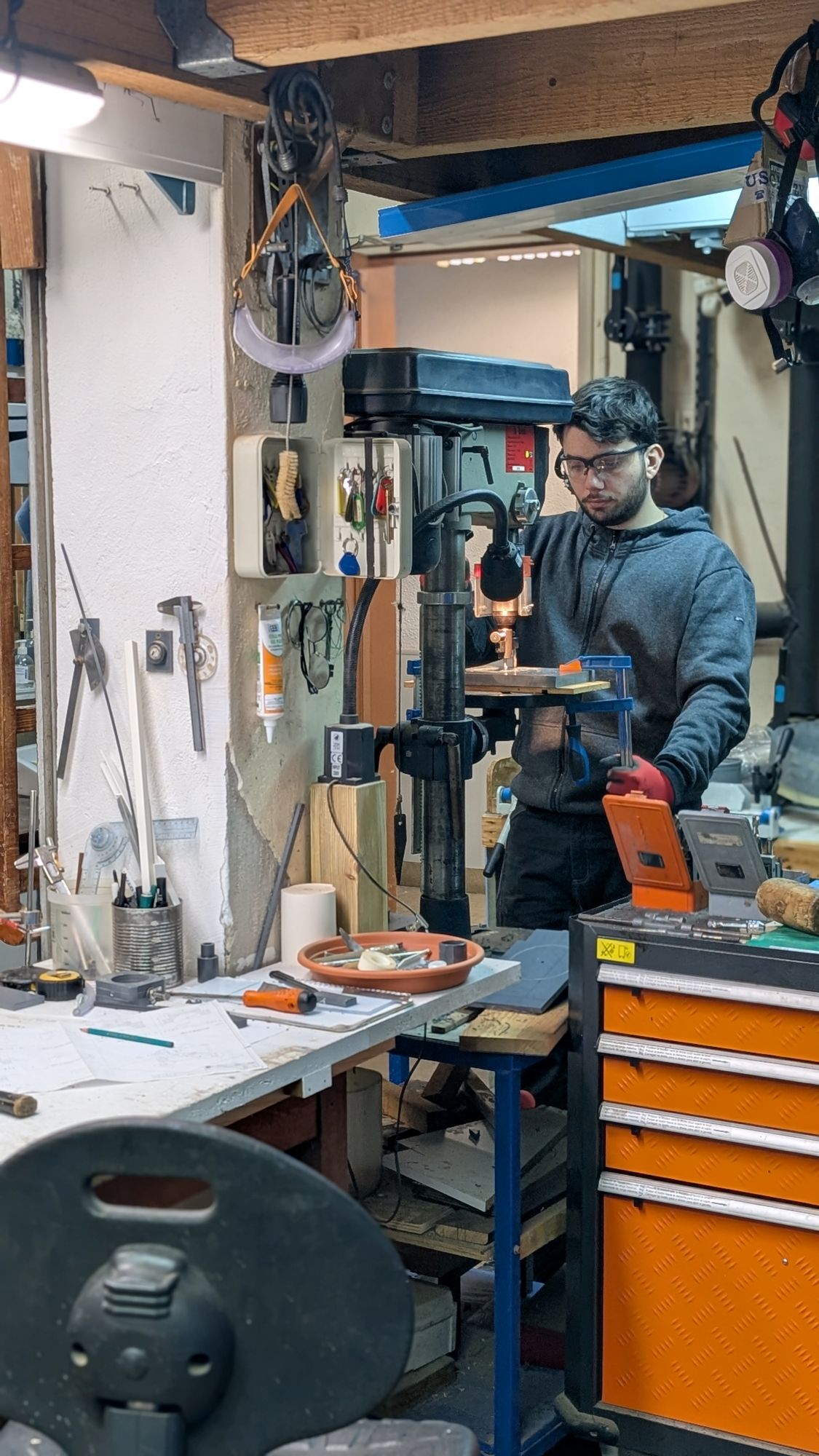
©EPOC : Alexis Bonnet

Could you introduce yourself?

My name is Alexis; I’m a mechanical engineering technician at the University of Bordeaux, based at the Arcachon Marine Station within the EPOC laboratory. I joined the team a few months ago and I must say it’s a truly unique working environment. Between the wide range of research topics covered by the laboratory and the exceptional setting of the Arcachon basin, this is far from an ordinary job.


What is your role at the EPOC laboratory?

My role is to ensure that everything runs smoothly so that the research teams can work in the best possible conditions. In practical terms, this involves maintaining the facilities, servicing the equipment, and sometimes designing technical solutions tailored to specific needs. It’s a role that requires versatility and a real ability to adapt—two qualities you develop quickly in this kind of environment.


Can you give us a concrete example of a prototype you’ve created or contributed to?

As I am still in the induction phase, I haven’t yet had the opportunity to contribute directly to a prototyping project. That said, this period is far from passive; it allows me to gain a clear understanding of the needs on the ground and to grasp the constraints specific to the station, which I believe is essential for me to be able to contribute effectively in the future. It’s a prospect that I’m really looking forward to over the coming months.


What are the main constraints or challenges you face on a daily basis?

The marine station is a technically demanding environment. Humidity, salinity and specialised equipment require constant vigilance and the ability to react quickly. We are regularly faced with unforeseen situations that call for effective solutions, sometimes under time pressure. It is precisely this unpredictability that makes day-to-day life stimulating and pushes us to excel.


If you had to encourage someone to join your field or the laboratory, what would you say to them?

I would tell them that working at EPOC means operating in an environment that is both demanding and deeply motivating. You work alongside passionate researchers and contribute — in your own way — to work that has a real impact on our understanding of marine and coastal environments. And then, it must be said, the setting of the Arcachon Marine Station is exceptional. For someone who enjoys hands-on technical work and seeks meaning in their career, it really is the ideal place.


EPOC informations – may 2026

Similar articles

Emmanuelle Ducassou has been appointed coordinator of the European MSCA – C-BRINES project, ‘Global climate impacts of extreme brine input to the ocean’

The EPOC laboratory is involved in a new European project coordinated by Emmanuelle Ducassou. The C-BRINES project (“Global climate impacts of extreme brine input to the ocean”) has been selected under the Marie Skłodowska-Curie Doctoral Networks scheme, a highly...

Pint of Science event in Bordeaux! Three members of the EPOC laboratory will be sharing their research on 18 and 19 May!

From 18 to 19 May 2026, the Pint of Science event is making a comeback in Bordeaux. To mark the occasion, three members of the EPOC laboratory will be meeting the general public to share their research in a friendly and accessible setting.©EPOCThe Pint of Science...

My thesis in 180 seconds, Joanne Couallier, finalist from the University of Bordeaux

The challenge of this competition is to explain your research topic in just three minutes! A challenge that Joanne Couallier, a PhD student in climatology at the EPOC Laboratory, has taken up.©Kéwann MoreauOn 2 April 2026, the University of Bordeaux hosted the final...

EPOC Laboratory General Assembly 2026: a day of review and discussion at the Domaine du Haut Carré at the University of Bordeaux

The EPOC laboratory met on 30 January 2026 for its General Assembly, held at the Domaine du Haut Carré and hosted by the University of Bordeaux.©Kéwann MoreauThe day provided an opportunity to review the actions carried out in 2025 and share future prospects....

Lecture at ENSEGID by Professor Steven Loheide DARCY LECTURE 2026 on 16 March 2026

On Monday, 16 March 2026, at 2:00 p.m., ENSEGID (Bordeaux INP) will have the honour of welcoming the 2026 Darcy Lecturer, Professor Steven Loheide, a lecturer and researcher at the University of Wisconsin–Madison and an international expert in hydrology and...

PFAS, the eternal pollutants present in our waters – Le Parisien newspaper and Pierre Labadie

In this article, the newspaper Le Parisien interviews Pierre Labadie, who explains how PFAS accumulate in our water and the environment. He details the risks to health and biodiversity, and the importance of limiting our exposure to these substances.©Crédit photo :...

Press release – Ecosystem dynamics and cultural innovation during the Middle Stone Age in southern Africa

A new study published in Communications Earth & Environment highlights the work of Maria Sanchez Goni and Sara Garcia-Morato on the first subcontinental-scale reconstruction of ecosystem dynamics 180 and 30 millennia before present.©CNRSThis study provides a new...

Tap water and testosterone: AFP and Hélène Budzinski separate fact from fiction

Given the wealth of information circulating on social media, certain claims about the quality of tap water are causing concern. In particular, there is the idea that the presence of female hormones, oestrogens, could affect our health. What does the scientific data...

COASTAL RISKS | Vania Ruiz Gonzalez, project manager for the PSGAR CORALI and PEPR IRICOT research projects at the EPOC laboratory

Vania Ruiz Gonzalez explains her responsibilities within the PSGAR CORALI and PEPR IRICOT research projects. She discusses her work at the EPOC laboratory, the objectives of these projects, her role as Project Manager, and her career path.A video interview was...

Unusual visits organised by the CNRS return to the EPOC laboratory: ‘Marine sediments: a window onto the history of the Earth’ on 3 October 2025

The CNRS's Unusual Visits took place on 3 October at the EPOC Laboratory. This was a unique opportunity for participants to experience a real oceanographic campaign and unravel the geological and climatic mysteries of yesterday and tomorrow.The CNRS's Unusual Visits...