
Pint of Science event in Bordeaux! Three members of the EPOC laboratory will be sharing their research on 18 and 19 May!

From 18 to 19 May 2026, the Pint of Science event is making a comeback in Bordeaux. To mark the occasion, three members of the EPOC laboratory will be meeting the general public to share their research in a friendly and accessible setting.
©EPOC

The Pint of Science France association is returning to Bordeaux for a new edition of its festival dedicated to making science accessible to the general public. The concept is simple: to organise meet-ups between researchers and members of the public in everyday venues, such as bars or brasseries, with the aim of making science accessible to everyone.


This year, the EPOC laboratory will be represented by three of its members, who will share their work on the oceans and climate.

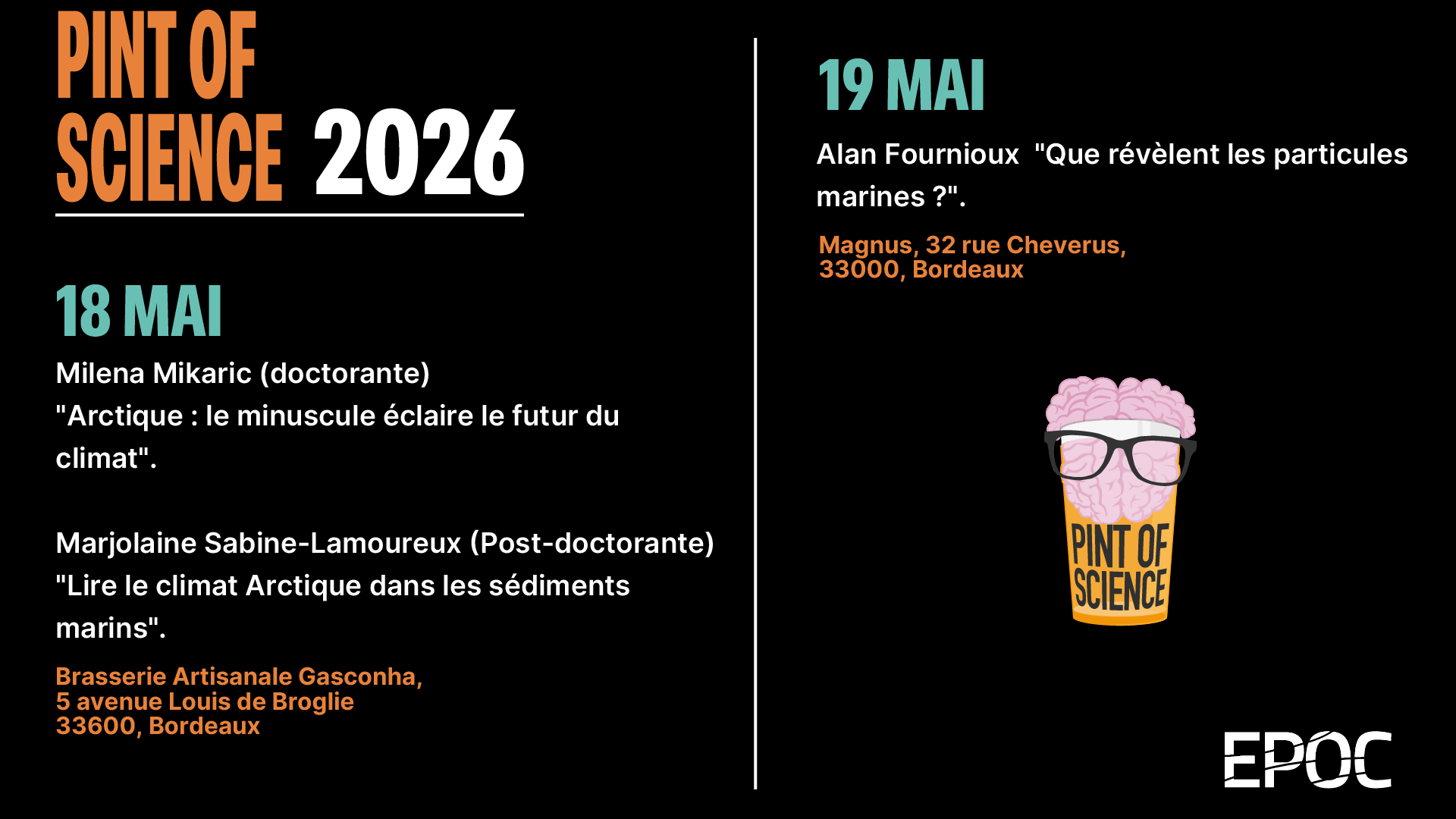
On 18 May, two talks will take place at the ‘Brasserie artisanale Gasconha’ (5 avenue Louis de Broglie, 33600 Bordeaux). Milena MIKARIC will give a talk entitled “The Arctic: the tiny reveals the future of the climate”, whilst Marjolaine SABINE-LAMOUREUX will present “Reading the Arctic climate in marine sediments”.

On 19 May, Alan FOURNIOUX will speak at the ‘Magnus’ (32 rue Cheverus, 33000 Bordeaux) with a presentation entitled “What do marine particles reveal?”.


Pint of Science offers an original way to discover science, encouraging direct exchanges with researchers in a relaxed atmosphere. A unique opportunity to gain a better understanding of current environmental issues whilst enjoying a friendly get-together.


To find out more about the programme and events:

 https://pintofscience.fr/event/ocean-entre-ecosystemes-et-menace-plastique/

https://pintofscience.fr/event/sous-la-glace-de-larctique/


Informations EPOC – avril 2026

Similar articles

My thesis in 180 seconds, Joanne Couallier, finalist from the University of Bordeaux

The challenge of this competition is to explain your research topic in just three minutes! A challenge that Joanne Couallier, a PhD student in climatology at the EPOC Laboratory, has taken up.©Kéwann MoreauOn 2 April 2026, the University of Bordeaux hosted the final...

EPOC Laboratory General Assembly 2026: a day of review and discussion at the Domaine du Haut Carré at the University of Bordeaux

The EPOC laboratory met on 30 January 2026 for its General Assembly, held at the Domaine du Haut Carré and hosted by the University of Bordeaux.©Kéwann MoreauThe day provided an opportunity to review the actions carried out in 2025 and share future prospects....

Lecture at ENSEGID by Professor Steven Loheide DARCY LECTURE 2026 on 16 March 2026

On Monday, 16 March 2026, at 2:00 p.m., ENSEGID (Bordeaux INP) will have the honour of welcoming the 2026 Darcy Lecturer, Professor Steven Loheide, a lecturer and researcher at the University of Wisconsin–Madison and an international expert in hydrology and...

PFAS, the eternal pollutants present in our waters – Le Parisien newspaper and Pierre Labadie

In this article, the newspaper Le Parisien interviews Pierre Labadie, who explains how PFAS accumulate in our water and the environment. He details the risks to health and biodiversity, and the importance of limiting our exposure to these substances.©Crédit photo :...

Press release – Ecosystem dynamics and cultural innovation during the Middle Stone Age in southern Africa

A new study published in Communications Earth & Environment highlights the work of Maria Sanchez Goni and Sara Garcia-Morato on the first subcontinental-scale reconstruction of ecosystem dynamics 180 and 30 millennia before present.©CNRSThis study provides a new...

Tap water and testosterone: AFP and Hélène Budzinski separate fact from fiction

Given the wealth of information circulating on social media, certain claims about the quality of tap water are causing concern. In particular, there is the idea that the presence of female hormones, oestrogens, could affect our health. What does the scientific data...

COASTAL RISKS | Vania Ruiz Gonzalez, project manager for the PSGAR CORALI and PEPR IRICOT research projects at the EPOC laboratory

Vania Ruiz Gonzalez explains her responsibilities within the PSGAR CORALI and PEPR IRICOT research projects. She discusses her work at the EPOC laboratory, the objectives of these projects, her role as Project Manager, and her career path.A video interview was...

Unusual visits organised by the CNRS return to the EPOC laboratory: ‘Marine sediments: a window onto the history of the Earth’ on 3 October 2025

The CNRS's Unusual Visits took place on 3 October at the EPOC Laboratory. This was a unique opportunity for participants to experience a real oceanographic campaign and unravel the geological and climatic mysteries of yesterday and tomorrow.The CNRS's Unusual Visits...

EPOC 2025 General Assembly: the laboratory organised Scientific and Technical Exchange Days at the Lycée de la Mer in Gujan-Mestras.

From 7 to 8 July 2025, the EPOC laboratory organised Scientific and Technical Exchange Days at the Lycée de la Mer in Gujan-Mestras.From 7 to 8 July 2025, the EPOC laboratory organised Scientific and Technical Exchange Days at the Lycée de la Mer in Gujan-Mestras....

The Emergent’Sea report provides an overview of chemical contamination along the French coastline.

Researchers from the EPOC Laboratory and Ifremer have published the Emergent'Sea report online, demonstrating the extent of this contamination, which affects the entire water cycle.©Laboratoire EPOCObjective: to investigate the presence of pesticides and...