Introducing the team :
Managers : Alexandra Coynel and Jörg Schäfer
The expertise of the TGM (Transferts Géochimiques des Métaux à l’interface continent océan) team aims to better characterise the biogeochemical cycles of regulatory trace metals ( ETM ) (Cu, Cd, Pb, Zn, Hg…) and emerging elements (rare earths, Pt, Co, Te…) at the continent-ocean interface.
The team’s activities consist of (1) identifying natural and anthropogenic (urban, industrial, agricultural) sources, (2) quantifying ETM flows in the different compartments in order to assess their respective contributions, and (3) studying the reactivity and fate of ETMs in contrasting aquatic ecosystems. The final objective is to deconvolute the biogeochemical processes involved in ETM speciation. To achieve this, the team is heavily involved in developing and optimising (1) analytical resources, (2) observation strategies and (3) experimental approaches.
Research areas and themes
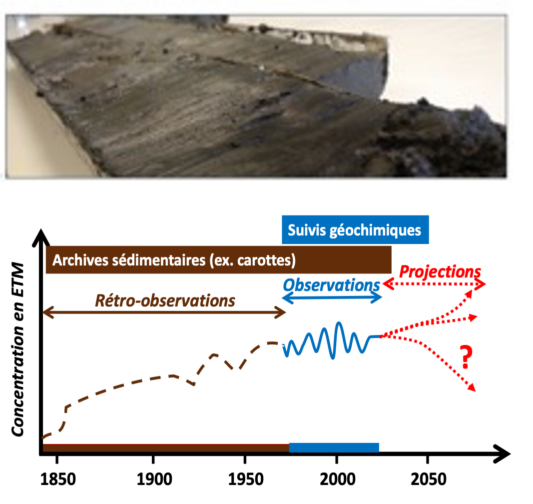
AXIS 1: Observation at different spatio-temporal scales: Transfers of conventional and emerging metal contaminants – understanding the trajectories of metal contamination
Coordinator: Alexandra Coynel
Our research activities focus on a multi-year observation approach through (1) hydrogeochemical monitoring at monthly resolution on the scale of the Lot-Garonne-Gironde catchment and (2) analysis of sedimentary archives. These approaches enable the impacts of intense natural or man-made events to be identified (e.g. flooding, dredging, industrial/urban discharges, rehabilitation works, catchment area regulations, etc.). This know-how has been transferred to other river systems in France and abroad.
Axis 2: (Bio)-geochemical reactivity of conventional and emerging trace metals
Coordinator : Jörg Schäfer
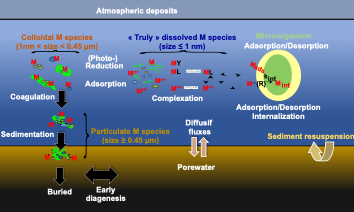
The (bio)-geochemical reactivity of ETMs in different environmental gradients (salinity, redox, turbidity) varies greatly according to the experimental conditions and the specific properties of each species and shows differences according to their natural vs. anthropogenic origins. Understanding the reactive transfers of the different metal types is essential for interpreting and assessing the geochemical signals recorded in different environmental archives, as well as the potential for transfer to biota.
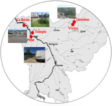
Observation network for polymetallic contamination in the Lot-Garonne-Gironde continuum
For over a century, zinc ore mining in Viviez (Aveyron) resulted in hundreds of tonnes of cadmium being discharged into the Lot via its tributary, the Riou Mort. All this led to major pollution of the Lot-Garonne continuum as far as the Gironde estuary. Since 1990, the TGM team has been carrying out monthly monitoring to determine dissolved and particulate Cd concentrations and quantify flows at 4 strategic sites: the Riou-Mort at Viviez, the Lot at Temple, the Garonne at Port Sainte-Marie upstream of the Lot and the Garonne at La Réole, its outlet, upstream of the dynamic tide. Analysis of the temporal variations revealed a reduction in dissolved and particulate Cd flows along the Lot-Garonne-Gironde continuum, linked to the environmental rehabilitation work. This monitoring was used to observe other ETMs (Cu, Ag, Hg, Zn, Sb, REE, etc.).
Equipments / Resources
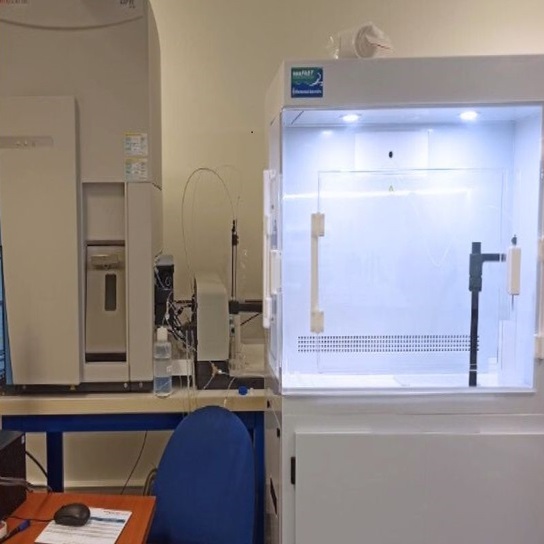
Analytical platform for Major and Trace Metals (M&Ms)
- The M&Ms analytical platform has been labelled and recognised as part of the University of Bordeaux’s platform network (FED) and has joined the CNRS’s REGEF network (Réseau Géochimique et Expérimental Français).
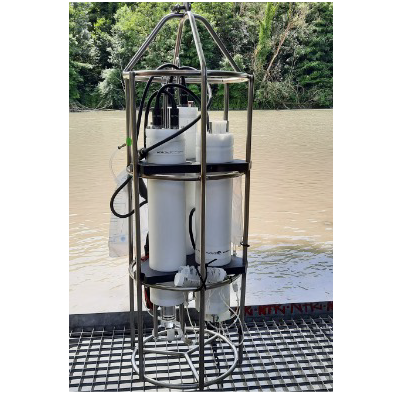
Tools and in situ analytical development
- The TGM team develops and optimises electrochemical techniques for the in situ measurement of the bioavailable fraction of ETMs in phytoplankton.