Introducing the team :
Manager: Bruno Castelle
The METHYS team’s work aims to better understand, model and predict the evolution of coastal systems from the scale of a few hours (extreme events, e.g. floods, storms) to multi-decadal evolutions, particularly in the context of climate change. An important scientific challenge is to identify the respective contributions of natural forcings, anthropogenic impacts (e.g. coastal structures) and climate change to both current and future changes in coastal systems. This also involves better identification of extreme events, their impacts and how these can cascade across large spatio-temporal scales. To answer these questions, innovative methodological developments are needed, particularly in the fields of satellite and video remote sensing, instrumentation and analysis of in situ data, and numerical modelling.
Research areas and themes
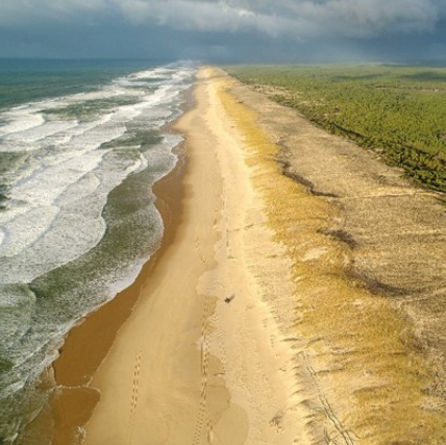
AXIS 1: Wave-dominated sandy coasts
Coordinator: Philippe Bonneton
The aim of this research is a better understanding of wave dynamics (transformation, breaking, energy transfer, etc.) and driven circulation (set-up, rip currents, etc.), as well as the morphodynamics of sandy coasts, from underwater bars to the dune ridge and the coastline. In addition to fundamental research, our work has numerous practical applications through collaboration with stakeholders (bathing safety, dune and coastline management, etc.).
AXIS 2: Coastal, lagoon and estuary environments
Coordinator: Isabel Jalon Rojas
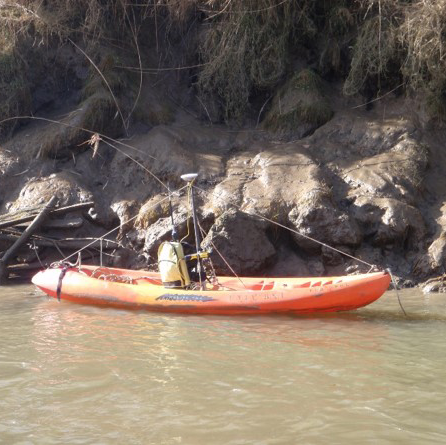
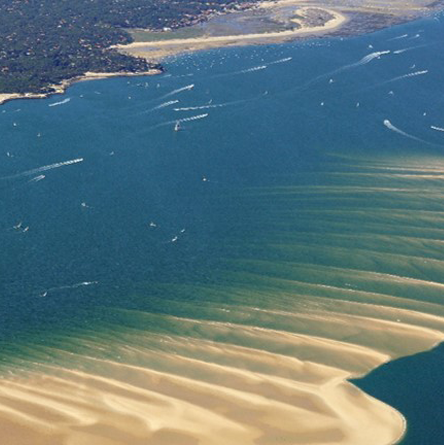
The aim of this axis is to gain a better understanding of tidal propagation, hydrodynamic circulation, the dynamics and flows of suspended matter (sediments and plastics), and their consequences on the morpho-sedimentary evolution of semi-enclosed coastal environments, such as estuaries, lagoons and foreshores. We also examine interactions along the land-sea continuum, helping to resolve both fundamental and applied questions relating to water quality, climate change and the impact of human pressures.
Cross-functional initiatives
Coordinator: Bertrand Lubac
These actions involve working at the interface between the two research axes, by studying the dynamics of the coastline adjacent to river mouths, improving multi-source bathymetric inversion methods, and developing exchanges on the concept of the ‘model’.
Equipments / Resources
Calculation codes :
- TrackMPD, LX-Shore, OpenTelemac-Tomawac-Gaia, 1DBeach, 2DBeach, Surf-WB, DUNE2D, SediMORPH, iFlow.
Remote sensing :
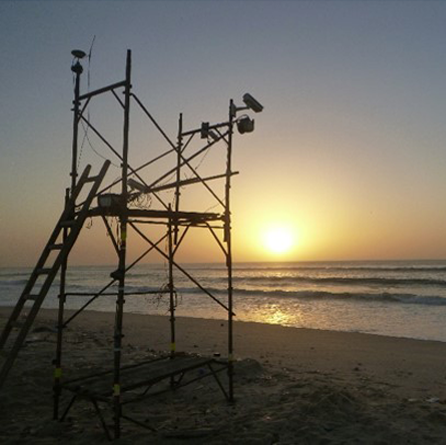
- Satellite, fixed video stations, drone (aerial and shipborne).