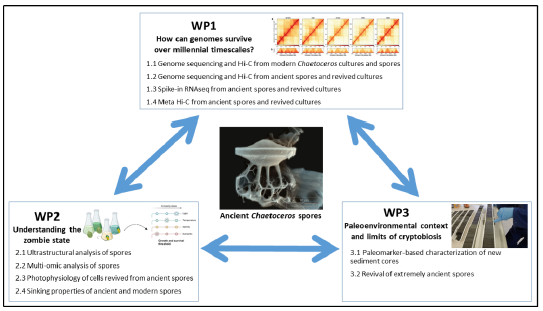
Ce projet vise à étudier les adaptations génomiques et physiologiques des diatomées marines à l’échelle de l’évolution, en mettant particulièrement l’accent sur les spores de repos de Chaetoceros que nous avons réactivées à partir de carottes sédimentaires antarctiques couvrant les quelque 10 000 dernières années, et pouvant remonter jusqu’à 3,5 millions d’années. Nous émettons l’hypothèse 1) que ces spores conservent des signatures génomiques et métaboliques qui leur ont permis de survivre à une dormance prolongée, et 2) qu’elles ont conservé des génotypes adaptés aux conditions environnementales du passé. Ces deux aspects seront explorés. À l’aide de spores anciennes et de cultures réactivées à partir de celles-ci, nous effectuerons un séquençage du génome complet, une transcriptomique par ajout de marqueurs et une analyse Hi-C afin d’étudier la structure du génome et l’expression génique. En parallèle, nous explorerons le métabolome et l’ultrastructure des spores anciennes. Les caractéristiques phénotypiques des cultures réactivées, y compris une évaluation de leurs photophysiologies, viendront compléter ces analyses, offrant une compréhension globale des capacités d’adaptation des génotypes anciens à des facteurs extrinsèques majeurs tels que la température, la glace de mer, la lumière, la salinité et la disponibilité des nutriments. Les résultats de ces analyses seront mis en corrélation avec les conditions passées à l’aide de proxies paléomarqueurs issus des carottes sédimentaires. L’objectif ultime est d’établir un lien entre la résilience génomique à long terme et la fonction écologique, offrant ainsi un aperçu de la capacité d’adaptation future d’une espèce marine clé confrontée à un changement climatique rapide. Plus généralement, nous mettrons en évidence pour la première fois